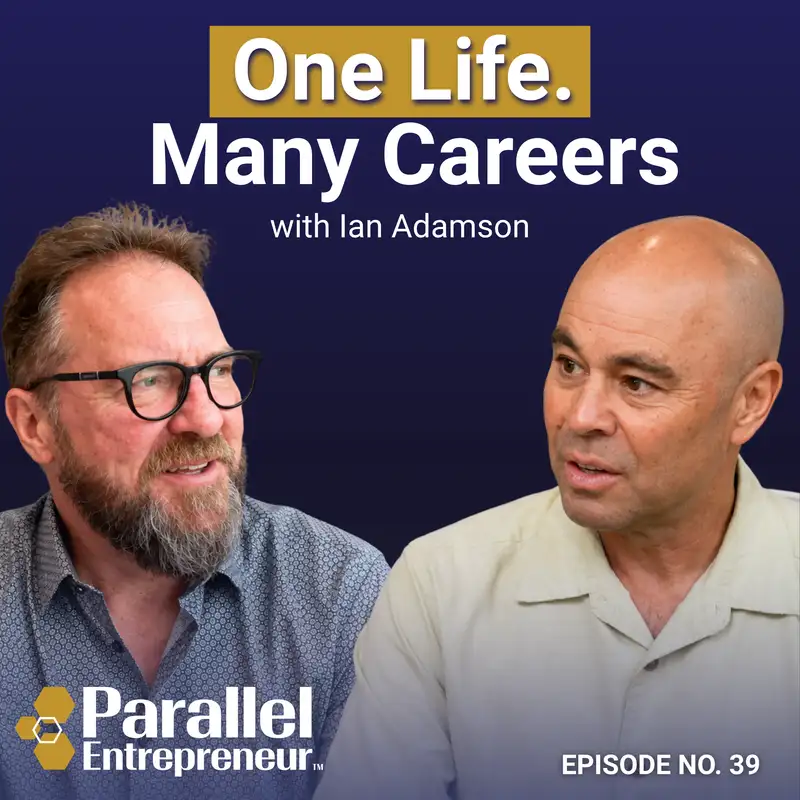
How to Build an Extraordinary Life Without Following One Path | Ian Adamson
Accumulation of knowledge,
experience, and education.
We all have that superpower.
The question becomes:
How much do you get on your
journey
through this life of ours to then
leverage into other things?
Well, you walked across China,
and then you walked across China
again. Like, who does that?
Why did you do that?
"The Chinese wouldn't let me out."
What would you say to your
younger self?
Nothing.
Not going to tell you anything.
You've got to figure it out,
because that's the fun part.
You know what the regrets are?
What you didn't do.
You know what you never regret?
It's the thing that you did do
that turned out to be a
catastrophe or a really weird thing,
but at least it's a story.
I've got plenty of those.
Welcome back to
The Parallel Entrepreneur.
Some guests you introduce
with a list of accomplishments.
In this episode,
Ian Adamson—
his accomplishments are so extensive,
the list would start to feel
like its own endurance event.
So we'll spare you
the full rundown.
Check it out in the show notes.
The CV—
the résumé—will blow you away.
But what I can tell you
is that today's guest
has moved seamlessly between
engineering, elite sports,
television production,
product innovation,
and global competition
leadership—the entire landscape.
From working with brands like Nike
to helping shape the future of
obstacle and multisport racing
at an international level.
It's a career that doesn't
follow a straight line,
and that's exactly what makes
it so interesting.
There's a lot more behind that story,
so stick around and discover some more.
I'd just like to say,
welcome, Ian Adamson, to
The Parallel Entrepreneur, brother.
My first question
is really around
how you manage energy.
Give the audience
a sense of what you're trying
to accomplish today,
and then I'm interested to hear you weave
into how you manage your energy
levels and productivity
on this multiple-paralleling
thing that you're doing.
It's not
multitasking,
which I actually don't believe in.
It's multi-switching.
Your ability to concentrate
on something
and focus on it,
uh,
to the exclusion of everything
else allows you to do
something really well.
I don't believe it's possible,
certainly not for me...
opinions for a legal case and then
get distracted by my phone pinging
about something in Olympic sport.
It just won't work.
So, I have an ability
which has its own challenges,
to switch everything off,
focus on that one thing,
and then, when I'm done with
that one thing, immediately
switch to the next thing,
which could be completely
unrelated.
The energy part is interesting because
I think most humans probably require
some level of
downtime. Let's call it a quiet
space where you can think about
other things or just
kind of let your mind
go blank-ish, or not think about
whatever the job at hand is.
For me, it's manual labour.
I love building stuff, so,
fortunately, it does
kind of get into
my actual work in Olympic sport,
where I'm
often out working on events,
obstacles, and Ninja Warrior
kind of stuff.
So, that's me with my hands.
Most recently, my wife and I got
really into saunas.
So, in the last couple of months,
I built two saunas.
Really nice ones—
the kind you'd expect to find
in a Western
hotel spa.
With all the bells and whistles,
and for me, that would be
switching off in the evening.
I'd switch off my "chair job"
and switch into building a sauna.
And for me, that includes
opening up walls in the house
to run
240-volt electrical,
and then trenching for
conduit to get to the solar
stuff, right? So that's manual
labour—framing,
everything
you would do to build a house,
which I can do, by the way.
I've actually built houses,
so I can actually do that.
That's the engineering side.
That's my engineering
brain going, "Oh, this is great.
Now I get to wield a hammer,
dig a hole, connect some electrical
things, hopefully not
blow myself up."
And that's, you know,
this other part of
energy management.
Where does the energy go?
The energy could be
physical, mental,
emotional, or spiritual,
and for me, downtime comes from
switching
between things.
Switching from, say,
concentrating on Olympic sport
to legal forensic work,
to building a sauna.
or riding my mountain bike.
There you go. I call that context
switching. I think it's a superpower of parallel
entrepreneurs. Let's just delve in for a minute into
your accomplishments—
your gold medals, your world champion
status in different sports. I'd like to help
set the stage by asking the question:
How many medals have you had
around your neck, and which one are you most proud of?
I have three X Games medals—
gold, silver, and bronze in the X Games.
That was in the beginning of
my career as a professional multisport athlete with Nike.
That involved
many events, mostly multidisciplinary sports.
At the time, adventure racing
was a big deal as a televised,
big broadcast, big-money sport
that lasted until about 2006,
which is when I retired.
So, that was one of a swag of
world championship wins. I think
our team won about 30 over that period.
I won 23 medals, including 11 gold,
during that time. How does training
for an athletic event in your career, and
building media and entertainment strategies around it,
and then trying to build an international Olympic
alignment around this becoming a new Olympic sport—
those three things are an astonishing
set of accomplishments
that seem almost routine for you, Ian.
But there must be a superpower
that you've uncovered. What do you think it is?
The ability to absorb information
and use it for some purpose.
If you look at the formal
education system, that's part of it. We go to
kindergarten, elementary school, grade school—
it goes on and on, right?
The further you go, the more you accumulate.
Now, that's the academic side.
But accumulation of knowledge,
experience, and education
is exactly what you're describing.
We all have that superpower.
The question becomes:
How much do you get on your journey
through this life of ours to then
leverage into other things, which makes it easier?
Another example
I think many people appreciate is language.
Understanding one language, or speaking a language
fluently,
as a kid—or learning multiple languages as a kid—
makes it much, much easier to learn more languages.
And the Pope—Pope Leo, I believe—
speaks 12 languages fluently.
I've heard him speak
French, and I couldn't tell
he wasn't French.
Not that I understand
French that well, but I'm listening
to the guy thinking,
"That's extraordinary
that he can do that."
On the other hand,
he's dedicated his entire life
to doing exactly that,
which is what you're asking about.
He did it.
Leonardo da Vinci did it.
Michelangelo did it.
It's not that
they were extraordinary people,
although they became extraordinary.
We can all do that.
We can all be extraordinary,
should we choose to do it.
I think most people just don't
have the will
or
the desire. And that's not wrong.
Maybe you like sitting on a beach
drinking Mai Tais. If that's your goal,
then do it. You've achieved it.
That's just
not my goal.
So, little Ian Adamson,
at seven years old,
was looking through the
Guinness Book of World Records, trying
to find interesting, challenging things,
and then you set yourself a goal
of becoming a Guinness World Record holder.
Yeah.
You asked about Olympic sport.
It all ties together,
by the way. All these things we do—
you do it, I do it.
I've seen
your remarkable career
through many things,
and they're all complementary.
Whether it's
making socks or running
a hobby store—
whatever it is,
all of that matters,
because all of it
becomes part of you.
You are
the sum of your experiences.
If those experiences include
knowledge and education,
then the sum of who you are
includes a lot of valuable things.
Ian, you're the President
of the international governing body
for obstacle sports...
Big vision—what's been
your biggest challenge?
The biggest challenge with, uh...
building an international
multisport federation,
which is technically building
a sport—or sports—
is dealing with people.
But I think that's the same
in any business.
It's the people.
Humans can be terrible people,
and there can be lots of challenges
around people management.
People management.
We believe—without hard data—
there are at least
20 million people doing
obstacle sports
around the world,
in about 140 countries.
So, building an international
organization is
a bit like the United Nations.
Each country
has a national governing body.
That national governing
body is then a member of the
international governing body.
The international governing body
then manages all of that,
and it's a scalable system.
Directly within
the federation system,
it's about 800 people.
That's not insignificant.
I'd guess that's a medium-sized
company by most standards.
A medium-sized,
small multinational.
But now, as of today,
it's been formally announced,
I am the Chair of the
Obstacle Commission
for World Pentathlon.
On March 15 this year,
our organization
voted to dissolve itself
as we integrate
into
World Pentathlon and the
Olympic Movement.
So all of our sports
are being aggregated into one
international multisport
organization,
which is World Pentathlon
Multisport.
That organization has been part
of the Olympic Movement
for 100 years.
It was created by
Baron Pierre de Coubertin,
who created the modern Olympics,
so it's a really interesting history.
to house the most complete athlete, or identify
the most complete athlete. The story goes that
he based it on a courier on a battlefield, taking
a message from one general to
another general on the other side.
So, he would run out of the tent, grab a random horse,
gallop across the battlefield,
use his pistol to defend himself,
run out of bullets, draw his sword, and his horse
would get shot out from under him.
He'd then have to swim across the river and run away.
So those are the five disciplines:
shooting, fencing, running,
swimming, and riding.
So, you've also produced a lot of television content,
starting with
adventure racing, right? And then moving into
American Ninja Warrior.
I went to the set and met
Travis McDaniel, the owner.
He passed away tragically from cancer, but
Travis and I had a chat,
and I did what we often do in television
for impossible projects, which is to say,
"Hey,
this hasn't happened yet,
but let's just say, hypothetically,
we managed to get an event into the Olympic Games.
Would you be interested in collaborating
to get there?"
And Travis was like,
"Yeah, that sounds great."
We've stuck together ever since, and the current—
or rather, the most recent CEO—
was actually on my board
for World Obstacle.
I had to keep people close.
on my board. Joe would call me
every now and again,
and he'd say,
"I've got this new event.
It's fantastic.
It's called the Death Race."
"That sounds great, Joe.
That's a great idea...
...until it happens."
"I know, right?" And it's still going.
The Death Race
is still going.
So I said,
"That sounds great, Joe."
Then, by 2009 or 2010,
he had started Spartan Race.
Same thing. He'd say,
"Hey, Ian,
I've got this. This is going
to be the best one yet.
This is going to be amazing."
So he started Spartan Race,
and I was like,
"Yeah, whatever, Joe."
Not really interested.
It's huge.
It's unbelievable, right?
It became maybe the biggest
endurance event producer
in the world.
They have more people doing
their events
in one year, in one country,
than Ironman does
worldwide.
That's how big they are.
They're massive.
And here's your answer,
right?
You get something out of the blue,
and you go,
"That sounds great.
Let's do it. It's an adventure."
Exactly.
Exactly.
I think that’s a common thread in
our conversation:
some unknown, unexpected thing will
always put an opportunity in front
of you, and you get to say yes or
no. I think a
lot of people say no to a lot of
stuff they should just be
saying yes to. You know what the
regrets are? What you didn’t
do. For sure. It’s
like, “Duh, I wish I’d done that.”
You know what
you never regret?
The thing that you did do that
turned out
to be a catastrophe
or a really weird thing. At least
it’s a story.
I’ve got plenty of those. Yeah. With
some
of our experiences, most of them are
failures. But that’s the
truth. People go, “Oh, you did
all this stuff. It looks amazing.”
And it’s like, “Yeah, what
you haven’t seen, and
what I don’t really talk about,
is all the stuff that went wrong.”
Right, because
most of it
goes wrong most of the time. You
just
have to accept it and roll with
it. The attitude, for me anyway, is:
“Okay, that didn’t
go as expected.” That’s usually what
actually happens. It didn’t go
as expected. But you know what?
That was a really, really good
lesson, and next
time I’m going to do it better,
because
I just learned how not to do it. Now
I know a much better
way to do it.
Or, if it didn’t go as
expected, there’s an opportunity
that was better
than you’d hoped. Exactly. This
whole thing is about whoever
said, “You’re the sum of your
experiences.” We
are the sum of our experiences.
And if the journey is
an unexpected one, and it is the
journey, because what
else are you going to enjoy? If
you don’t enjoy the
journey, which is life, you may as
well
not live. So enjoy whatever you’re
doing.
I
asked you a
question in one of our many catch-up
calls,
because on the podcast I’ll ask,
“Knowing what you know
now, with all these
experiences, what would you say to
your younger self?”
Nothing. Nothing at all? You
feel like you’d walk up to
your younger self and say, “Hey,
dude, nothing”? Yep.
No. I’m not going to
tell you anything. You’ve got to
figure it out, because that’s the
fun part.
You had a lot
of experiences in China, and I think
one of them that
still leaves my jaw dropped
is when you walked across China,
and then you walked across China
again. I mean,
who does
that? Why did you do that? I had
taken
a year off in 1983 after high
school to travel and
sail. That was a sailing thing. I
did two years of
school, then went back out for
another year. But it
was more than a year, because
Australia’s school
year, like most school years, is
actually about
15 months. So I had a bit of time
to poke about. I flew to Hong Kong,
then took
the ferry over to Macau
and went into China. At that time,
you were officially
allowed to visit, I think,
Beijing, Guangzhou, Shanghai and
maybe some
tourist spots. That was it. You had
this
sort of permit thing, a little paper
book that allowed
you to go places. But when I was
younger, I looked quite
Chinese, so I just bought local
clothing
and took off. I ended up going
out to Kashgar, far western China.
I started out on a steam train,
ended
up getting out there, and then tried
to cross into Pakistan.
Pakistan was a Commonwealth country,
so
at the time, with an Australian
passport,
I did not need a
visa for Pakistan. But
the Chinese wouldn’t let me out
because they said, “You need a
visa for Pakistan.” I said, “I don’t
need a visa. I’m
a Commonwealth citizen.” They
said, “You do need
a visa.” I finally went back to
Beijing. This was
like the second crossing
back to Beijing. I went to the
Pakistan
embassy and camped out there for a
week trying
to convince them I needed a
visa, which I didn’t. They didn’t
want
to give me one because they
said, “You’re a Commonwealth
citizen. You
don’t need a visa.” I finally
convinced them,
so they gave up and said, “Okay,
here’s your visa stamp.”
I got the visa, went back to Kashgar
— that
was my third crossing in China — and
then
I was standing at the border to
Pakistan.
It’s no man’s
land. It’s like 100 kilometres of no
man’s land. I was
standing there in a high-altitude
desert. There
was nothing there. There was
actually a sentry with
a little pillbox, a boom gate in
a vast empty space, and his rifle.
That was it. I
thought, “Okay, now what do I do?”
In the far distance,
as I was standing there, this little
cloud of
dust appeared and got bigger and
bigger. Then there
was a white Toyota Land Cruiser with
a
whole bunch of French journalists.
They said, “We’re the first people
to
cross the Karakoram to
Kashgar and into China in
100 years.” I said, “You are from
south
to north. I’m going to be first to
do it from
north to south. Can I use
your car?” They said, “No problem.
We’re out of here.”
So I jumped in
their vehicle with a friend of
mine and we went south. We believe
we
were the first
people to have done it in
100 years, on 19
May 1986. Then I got
really sick, and there’s a whole
other story
around that. But that was part of my
tooling around on foot
in 1986. When you decide you’re
going
to do something,
what’s the next step for you?
How do you break problems
and challenges down into winnable
parts? I switch my
brain to the engineering side. I
go into project-management mode, and
that means creating
a schedule with goals, dates
and action items. Sometimes it’s
mental; mostly,
I put it out in the
calendar. But everybody, I
think, has to have some kind of way
to reach
down deep and pull in that extra
ounce of motivation, whatever
that is, in order to
accomplish and overcome some
significant challenge. What
would be an example of that from
your experience? The motivation
while we were racing changed over
time. In the early
days, it was to see if
we could finish. It started as fun
and new and exciting. Then it became
professional
and exhausting. Then the races
became, “How can we
make
this enjoyable?” So it would be:
“Let’s just get ahead of
the other teams as far as we
possibly
can, then sit down
and look at the view.” That’s what
it ended up
being, because at that point it was
coming full circle. What
made this
great to start with? It’s an amazing
place. It’s beautiful.
It’s this pristine forest. It’s
gorgeous. There are jumping whales
in the Arctic
Circle and rainbows. That was the
fun stuff. I
just wanted to do
that. I didn’t want the other stuff.
I just
wanted that stuff. We talked about
the experiences
you’ve had, and I’m gathering this
sense that it’s not just
that you know what to do, but that
you know
how to
handle the unexpected. Is
your experience knowing what to do
most
important, or is your experience
knowing
how to handle the unexpected most
important? Let’s say
you have a fine
arts degree, but you end up being
a TV producer. It doesn’t matter
what the degree
was. What you learned
at school was how to
learn. That’s ultimately what it
was.
Most people going to school have no
idea what they want
to be at the end. They probably
switch
majors twice. I guess
it’s not uncommon. Why? Because
we’re finding our way.
School is a journey, and that
journey teaches you all
sorts of stuff that you need later.
So go to school. Why? What
do I do? It doesn’t matter.
I’m not going to
tell you what to do. That’s like my
former
self. Would I tell my former self
what to
do
at school? Hell no. Go figure it
out. Do something and figure it
out. I remember you teaching me
about running barefoot and the
mechanics of running. I was
training for some triathlons at the
time, and
you were saying it’s impossible to
run with bad running mechanics
if you’re barefoot. My
mind was short-circuiting. I put
some Swiftwick socks
on and went out and started running
barefoot,
which was actually spectacular.
It was very, very weird. It’s crazy
weird for
people who wear shoes, and
most humans on Earth
really don’t, by the
way. If you’re wealthy
enough to afford them, you do.
That’s a whole other conversation.
You should have Mark
Cucuzzella on this, Mark. I’m sure
you
know Mark.
You built stuff for him. We went
through that
whole compression thing with Mark.
That’s right. Developing the
compression socks, which I still
use. They’re spectacular, by the
way. We were
trying to develop
the world’s best compression sock,
and they arguably were.
I still use them. I still
have them. I only use those ones.
They last forever. They
were medical-grade compression
socks. When I retired from the
company, leadership
ultimately decided to abandon
that particular initiative. What I
find
in my own professional life is that
I’m going to push the edges, push
the boundaries, and try to
figure out why something cannot be
done. I don’t have
preconceived notions about
why something I don’t know how to do
can’t be
done. So
I’m going to go figure it out.
I wanted to make a medical-grade
compression sock that was not going
to wear out. Boy, we got some
balloon-toe
stuff going. You and I
were like, “We literally innovated
in that
space.” But then the company decided
to
stay focused in a different
area, and we were never successful.
Actually, that’s a
failure of mine. We had the world’s
best medical compression sock,
and I priced it
too low. This is a lesson. I priced
it too
low. The market thought that a great
medical compression sock
had to cost $80, and
I thought that was ridiculous
because
it should be about $35 or $40, and
we
could produce it profitably for
that. If you’ll
remember, we were out there building
the world’s
best sock, and at $40 a pair, people
didn’t buy them. The medical
community didn’t buy
it because of preconceived notions
about price points
and value. Market forces have come
to
bear, because I was in the pharmacy
at the
local hospital just the other day,
and
they have racks of medical
compression socks now which are
at a reasonable
price — the price you had
originally. You were too far ahead
of the game. I
mean, this is a common problem:
being too early.
Lia suffers from the same thing.
She’s
always too early. Her business
suffers a bit
because she was too early into the
business. The good thing
is she got the patent, so that’s not
too early. She
did it with online fitness
programming. When I first met
her in 2004, we went down
to a studio of a friend of
ours in Denver to
produce a Fit Tip
of the Day: fitness workout videos
for
mobile devices. Motorola said, “It’s
never
going to happen.” AT&T said, “Nope,
not a chance. No one’s
ever going to do that. No one will
ever look at a phone and do a
fitness workout or have
anything to do with that. It’s just
a
stupid idea.” Lo and behold, that’s
probably the
only thing people do
now, because it’s right here.
Whether
it’s on your spin cycle
or whatever, it’s going to be on a
tablet. It’s going to be right in
your face.
Lia had produced a whole series of
these things. We were
the crash-test dummies. We were the
cast in
it. It was good. Fit Tip of the Day.
But
the same thing: too early. People
were like, “No, people
aren’t going to do that.” Until
someone does. We don’t
really know what we want until
someone shows us what’s
possible, and then many people, most
consumers, have
their eyes opened. It’s
not like you’re looking at
a market and everybody wants this,
so you’re going
to deliver it. It’s more like, “I’m
going
to create this, and the
market exists, but the timing is
off, or
the capital formation is off, or the
reason we fail is
that we don’t have the right team.”
What
do you think the antidote is? You
just
keep after it, or then what? Yeah,
you do
keep after it and apply
pressure. Constant pressure. I
call it just applying constant
pressure. Inevitably, you are not
the
first —
maybe not even the best — but if
you’re the guy
who applies constant pressure,
that’s the one that’s going to
stick.
Here’s a parallel for you on this
exact topic.
In the 1890s, there
were four Olympic Games.
There was an American one, a French
one,
a Greek one and
a British one. The Hellenic Games, I
think,
are still going. The one that we
know
today has its own
history, but you get to write the
history if you’re the winner.
You have a hard time
finding these other Olympic Games,
and one of them
was around for at least 60 years
before
what we know today as the modern
Olympics. Baron Pierre
de Coubertin, the founder of modern
pentathlon and the
founder of the modern
Olympics, won. That’s the one we
know.
The only games we know today
are the ones
we know because he won. He was
smart.
He went to Rugby School
in England to learn how to do sport,
because
Rugby School in England — the
British, really — invented modern
sport as we know it.
All the football codes came
from Rugby School in
England: American football,
Australian football, rugby union,
rugby league
and soccer. They all came from
Rugby School in England.
So did the modern Olympics,
ultimately, because
Baron Pierre de Coubertin was an
educator
and he understood school and
education. He
went to
Rugby School. Over the gate to this
day is
“Faster, Higher, Stronger” — Citius,
Altius, Fortius.
It’s on the gate to this
day and has been there since Baron
Pierre
de Coubertin went there. That’s
the Olympic motto. So Rugby
School has a lot to answer for.
These games died out in competition
with one another
until there was an emerging winner.
They were
all there at the same time. It’s
kind of like humanity. Our species
walked
the Earth at the
same time as the Cro-Magnon
— or wait, no,
Neanderthals. I think there’s
fossil evidence that Neanderthals
were walking and
existing on Earth at the
same time as what we
would consider modern humans.
Bigger, stronger, smarter, but
not more successful. There’s a
difference. What’s the secret? It
really goes
back to the title of
this show, which is
Parallel Entrepreneur. I think what
humans can
do quite well is that they have
a capacity to do things in
parallel. If you are
single-minded, single-focus — bright
light, narrow focus
— you can get something done really
well, but you might fall off a cliff
doing it
because you’re not paying attention
to what’s
around you. What humans have a
capacity to do, not
that they always do it,
is to have awareness of other stuff.
Some
people do it
way better than others. Survival
studies show, I think based on
airplane crashes,
that about 10% of humans
will probably survive when something
unusual
happens. I would probably class
you in that.
You would be that person, because
you’re thinking outside
the box. You’re thinking, “What
else is going on?” That’s curious.
Most people aren’t
like that. They’re stuck to their
phone, or they’re single-focus.
They’re not paralleling it. They
don’t have
the awareness of
the other stuff. If you don’t have
that awareness, you’re
probably going to fail
if something really goes wrong,
because you didn’t realise there was
an exit on your
left three steps back. In a plane,
you might be like this:
do you know where the exit
is? I pay attention to the exits. I
absolutely do. Exactly. In front,
behind. Not only that,
you know the people around the exit.
The exit on the left has a big guy
in the
middle. I’m not going to go to that
one. The exit on the right has
a couple of kids. Help
them out and then
go out that one. It’s
kind of like that. I guess the
military calls it situational
awareness. I think some
people innately have that.
You also know the
semi-trailer in the right
lane coming at you from behind. If
you
don’t know that and you’re driving,
you’re an idiot, because
that’s what’s going to get you. But
most
people are like this: they just
focus on the road, tunnel
vision down the road. Terrible idea.
There’s a certain numbness
that I think we
can observe. I find when
I talk to people about
paralleling and parallel
entrepreneurship — my careers
overlapping, my
companies overlapping, some of them
being obviously
synergistic and some of them not
obviously synergistic,
from short-sea shipping to sock
manufacturing — they’re
all opportunities to learn
for me. They were all
things that interested me, and I
never thought I
couldn’t do it. But I
do
hear, when I start talking to people
who don’t make
the show, that they’re not the
right fit. Why? Because they’re
great entrepreneurs, but they
really just think they can only
focus
on one thing
and that’s what’s going to make
them
successful. I’m sure it does in most
of those cases. No question, they’re
successful. But there is some
form of self-limiting
belief there. I want to pull on that
thread in this world of parallel
entrepreneurs. From
the outside, it would be, “Oh,
you’re really successful
doing stuff.” From the
inside, it would be, “Yeah, parallel
entrepreneur. That makes complete
sense to me.” Lia won
Entrepreneur of the Year for EY,
some major award
for Ernst & Young, a few years
ago. Then she got to go
to the EY annual
shindig over in Palm
Springs or Palm Desert, which is
astonishing. The way
it works
is that the top couple of
hundred people in the world
— leaders in their
fields, in innovation and startups —
get to be
those people. It’s not the Fortune
500. It’s the
cream of the
crop. It’s the top of the top. Every
single person there
has this parallel entrepreneur
mindset. They use many
different terms to describe
it, but every conversation is going
to be
like this conversation, for days.
It’s exhausting because it’s so
engaging
and incredibly insightful. You leave
and you
need a year to recover because you
learned so much in
such a short time and made
so many connections. You can also
see how
it’s so perpetuating, because
every conversation ends with an
unexpected outcome: “Oh, you do
Olympic
sport? Oh, you
do this? We should do this, and
I do that.” It’s exactly
what you want and expect,
but also unexpected at the same
time. The expectation is that every
conversation will be fascinating and
there will be an unexpected
outcome. Everyone knows it, and
everyone’s there for that. Ernst &
Young, which a lot of
people don’t know, is one of the top
four accounting
firms in the world. Their success is
not only that
they’re an accounting firm,
which they are staggeringly good at,
it’s that
they are connectors. They
don’t ask for anything, ever. They
are
not promoting themselves at all.
They don’t need to, by
the way, because they’re that good.
Being associated with EY at any
level is a big
deal. It’s like having a PhD
from Harvard, or whatever you want.
It’s
like, “Oh, you’re
an EY alum? Let’s have a chat.” My
friend Brandon shared
a piece of advice recently: dress
so that if someone
dressed up as you
for a costume party,
everyone would know it was you. Now,
that’s not entirely
about clothing. That’s about
identity,
about showing up fully.
My wife, Jenny, and I are leaning in
on
this concept,
both in our personal lives and now
in
a little startup we call Happy
Overall. We’re making
overalls. Each one is made
to order as a wearable canvas for
art: overalls that
are comfortable, durable and
expressive. We’re
sourcing soft 100% cotton. We’re
partnering with designers and with
local seamstresses who love the
artistry of a
well-crafted piece of
clothing. We’re launching in summer
of 2026, so
check out happyoverall.com to see
pics and
see if anything resonates with you.
Fully you, and
it’ll happen every
time you reach for them. If you want
to be part of
the first run, join our waitlist
at happyoverall.com. I was watching
a show. When I
can’t sleep, I watch
something odd with Neil deGrasse
Tyson, or something
on YouTube that is research
and is going to
expand my mind because I’m
curious. I started watching
something the other night
about sperm whales and the AI
decoding of their
language: 9,000 recordings and how
they set
up the audio, almost like
a TV production. They showed
how they went about laying out
the sonar and the audio recording
devices, and how they placed them
on the pod —
the female leader, the male
leader and the kids — and how they
were
able to triangulate in
order to know which whale was
talking to which whale. They made
the assumption that they could
figure it out, and then they had
this massive amount
of data. The conclusion fascinated
me:
they are speaking a fully developed
language with vowels.
They’re addressing
one another and communicating in the
same way
that humans communicate,
and they’ve developed this over
their
own millions of millennia.
We just think they’re clicks, but in
fact we’re wrong.
It’s a complete language that we
can decode and communicate with.
Now, have
you seen a whale that would coach
you on
where to stay, straighten up your
sailboat and
fly right? Strangely, cetaceans
sometimes do
assist humans on craft. In fact, I
think there was something
in the news recently about a whale
or a
dolphin or something that helped
someone. It’s
not uncommon. I’ve seen it before,
and that actually
doesn’t surprise me. That
clicking thing — the Maasai language
has clicks, so it’s not that
different from whales. How did that
develop? Who knows? That’s probably
not a connection. It’s a random
coincidence. That
brings up AI. I imagine AI had a
hand in
that because it would be able to
process that data quickly.
Yes, it’s about data processing. I’m
not really
into AI that much. I’m not allowed
to
use it for legal work
for lots of reasons, but it’s
fascinating. Lia paid a
company to predict how
many uses are in an
eyelash container. These little
tubes don’t have much liquid,
but you don’t need much. We were
questioning it, and then
Lia said, “Hey, let’s just have some
coffee
and do
the evaluation ourselves.” So we got
a bunch of
the containers of eyelash and
eyebrow serums
and started measuring uses. The
company had
done it on paper towels. They got
the little
wiper out, which is like a spoolie
brush you
use for mascara, and they were
wiping
it on paper. Lia said, “Well, that’s
not accurate because it’s not an
eyebrow.” So we did
it on our eyebrows. We spent a
morning
going through hundreds and hundreds
of uses
of these things to create the data
to see
if it was correct.
We scratched the hell out of our
eyebrows
because the little spoolie brushes
are kind of abrasive. Then our
eyebrows went
crazy, because when you scratch into
them and
expose blood vessels,
now the stuff is going right into
your system. That’s a
really good way to get the stuff
active.
We found that out later. That was
incidental. What
ended up happening was we had a
notepad
and we were writing by hand in
columns:
time, amount, weight. We had
a little microgram weighing scale,
so we’d weigh things and write it
down. We did
this for a whole morning, and by the
end,
we had thousands of
recordings. Then Lia took a picture
with her
phone. She has one
of the commercial-level AI
programmes, just
for her. She took a picture and
said, “Now what do
we do?” I said,
“Well, you want to run a
statistical analysis. Get the
standard
deviation, the mean, the mode, the
average, the
variation, and predict what it’s
going to do.” Basically, do all
the stuff we do
as engineers. I was there doing it
by hand just to check it, with
my calculator, old-school, pressing
buttons and writing things on a
piece
of paper.
AI did it in about 30 seconds. Then
Lia said, “Oh,
I’m putting it into a format that’s
acceptable by the regulatory
authorities in the United States and
in Europe.” This thing spat it
out so fast. I sat
there for an hour checking it, and
it was on the
money. I went,
“Holy shit, this is good.” It was so
much work.
I didn’t even run all of the stats.
I did a few basic things.
I didn’t do
the standard deviations, but
I did some of the basic stuff just
to check it. It was on the money.
It was just amazing. That’s been
my experience, although
lately, unfortunately, some of my
AI-centric projects feel like
there’s just
constant context rot. Keeping
it framed in and remembering the
progress we’ve
made to this point feels like it
always wants to start over again.
I’ve been focusing on accountability
and isolation,
and on how
to make sure I’m building upon a
previous
factual success.
Like that hour you spent trying to
validate the numbers —
it was right on. If
you kept doing that analysis, would
it get
less accurate over time? It’s been
frustrating and enlightening at the
same time for me. That conversation
about
AI — and I didn’t think
we were going to go there, but lots
of us
do today — my observation is that I
think we’re afraid
of the discovery. I think the pace
of
discovery is going to completely
surprise us.
If we want to learn, we’re going
to learn a whole lot really quickly,
really fast, in a
society that sort of likes things
not to be so
fast: “Slow down, junior.” I’m not
so concerned about the
job-loss kind of stuff as I am
about how we absorb new facts and
new
discoveries. Things like whales
communicating in full
sentence structure and addressing
one
another the way you and I
are right now on this podcast
— is that going to blow some
people’s perspective, or
are they just going to ignore it and
move on as if they’ve got blinders
on? It feels like
a huge opportunity for discovery and
curiosity to really
take root with humanity. I’m not
afraid
of it. I’m frustrated by some of the
learning curves
I still have to overcome, but it’s
exciting. It’s a
very
exciting time. The thing I find
exciting about it is that it’s
unexpected. We don’t know.
We can’t predict it. It’s moving
quickly.
That’s fun. I love progress. I see
the spectrum of mindsets in things
like construction.
Behind our place in California,
they’re building housing for
academics. It’s about
100 homes on a big, nice piece of
property that the university owns.
Some of
the neighbours are like, “This is a
disgrace. We
can’t have this progress. This is
going to
wreck the neighbourhood.” There’s
that NIMBY thing. I
look at it and go, “This is
fantastic. This is really
interesting.
I love how they’ve figured out the
traffic on this. I
like the process.” I
like change. I don’t like the fact
that we’re overpopulated by
80% of the humans on the planet,
but that’s another discussion.
People keep saying we need more
money
and more
people to create more money. It’s a
death spiral. I
hear that a lot from economists: “We
need higher birth
rates so we can generate more people
to pay for more people, to get more
people.”
It’s a terrible idea. What they’re
actually
saying is there will never be enough
people
to pay for the
people who are here, so you just
can’t keep making more
people. It causes all the
problems we have. It’s fighting for
space.
It’s all about humans fighting for
stuff,
and that’s a terrible idea. Japan is
doing just fine, and their
population is
declining, so do that. Quality
of life might be a better focus,
right?
Quality
of life. We can’t support this. We
have exceeded the ability
of the planet to support humans.
We exceeded the ability of the
planet to support
humans decades ago. Why do we not
believe that?
Who is feeding us this line of shit?
It’s
money. It’s all about the
money. Look at the idea
that you need a
higher birth rate to have more
people to
create more money to support the
people.
No. That’s an absolutely disastrous
idea. That’s a false
premise and one that is completely
flawed. There’s
nothing valid or rational about that
at
all. We’ve talked a lot about
adventure today,
and recently this trip taken around
the moon was
an imagination-capturing moment in
time. It reminded me
that those astronauts are athletes.
They’ve been
training for 4
Gs and more for a long
time. What perspective do you have
on the athleticism of
our astronaut population? Everyone
should
train to be an astronaut, and then
we’d
be way better
off. Astronauts are mentally,
physically
and emotionally
capable and competent humans. That’s
what we need. We need those people.
We want less thoughtless, mindless
robots and more thoughtful
people. I’m told that if you look
down at the Earth
and see the blue marble,
it completely changes you,
which I believe. Being
on the ocean is
the same. When you cross an ocean
slowly on
a little boat, you get a completely
different
perspective of the planet, and then
you realise how
incredibly large, delicate and
complex it is.
Maybe this is the last thing I’ll
say. In
1974, a gentleman sailed from Sydney
to Tokyo on a little sailboat and
wrote a book
about it. The book was about sea
life,
the birds, the whales,
the fish and the abundance of the
oceans. Many decades
later, I’m going to say 2004, he
repeated the journey. The thing he
wrote
about the wildlife was
that there was none: no whales, no
schools of
fish, no birds, didn’t catch
anything. Nothing. It was a
desert. I’ve seen it in person. I
was sailing in
the late 70s and the 80s, and my
memory
was the same. It didn’t take
long. In 2013, 30 years after I’d
been on the
Great Barrier Reef, I went back and
went sailing again to
places I thought I knew. I had my
wife and a couple of
friends, and we went out and said,
“We’re
going
to go to
the outer reef off Cairns, and it’s
the most
amazing thing you’ll ever
see in your life. It’s
indescribable.” I’ve actually dived
off Port Douglas and done the Great
Barrier Reef, which
was
astonishing to me. It’s been the
benchmark. That was 35 years
ago. Back
then, it was astonishing. In 2013,
10 or 12 years
ago, I couldn’t recognise it. It was
a desert:
a white, bleached, dead
desert of death. Now 80% of the
largest organism
that’s ever grown on the
world is dead. That’s just the tip
of the
iceberg, because that’s one of the
foundational pieces
of the entire ecosystem of the
oceans,
and it’s basically dead now.
That was in 2013, and that was
when I really paid attention to what
the hell we were doing, because
I was seeing it. I had sort of
been seeing it over time: “These
reefs don’t look
so great. This reef
doesn’t look
so great.” That was from Malaysia,
the Philippines, Indonesia,
the Mediterranean — all over
the world. I’d been seeing little
bits
and pieces and wondering why
it didn’t look so great. I thought,
“This
reef isn’t so good,” or,
“That island isn’t so good.” Turns
out, it’s the entire
ocean. The entire ocean has been
completely decimated. What are we
going to do about this?
What should we be
teaching ourselves from this lesson
called a dying ocean? Well,
to get rid of
the humans would be a start. We’re
the problem.
What we’re doing is
the problem. Being here is
the problem. It’s one reason we
don’t have kids.
Not the primary reason, but one of
them. We
could have had a
kid, I suppose, but bringing a human
into a
place already overpopulated with
humans is
a bad idea. Not that biological
drive isn’t going
to drive more humans to have more
humans, but there are
ways to do it properly. We do
not need 8 billion people,
or soon 9 billion,
on the planet. One billion is
plenty. That’s
sustainable. Every
biologist will tell you the same
thing. Every real scientist
will tell you the same thing. I grew
up
with parents who were
biologists, so we were schooled in
this before
it was a thing. They saw the signs.
They
saw what was happening in the
70s and 80s. But
now we know. Science is
so slow in confirming because you
have to disprove your
theories. People don’t know this,
but
you have to
try to disprove your ideas. That’s
good
science. Good engineering is the
same thing.
I have to prove that I’m wrong. I’m
going to
do everything I can to
prove this is wrong. Most people are
trying to validate why
they think it’s right,
and that’s a terrible thing to do,
because
it’s confirmation
bias. You say, “I’ve created this
thing. It’s the
best thing in the world. It’s
amazing.”
That’s a terrible idea.
If I build an obstacle for obstacle
racing, which I do a
lot of, I’m trying to figure out how
it
can be wrong, how it can break, how
it
can create a problem, or how it can
be dangerous. Most people don’t
look at it that
way. You are really focused on
safety. I am, especially because
my day
job as a legal forensic expert
is about risk, identifying risks,
hazards and dangerous conditions.
I get this answer a lot: “This
obstacle is fine because we’ve
never seen something happen on it.”
It’s
like, how many times have people
used it?
How many users do you have? They’ll
say, “We’ve
been using this for three years,
and we’ve had hundreds or thousands
of
people on it.” I’m thinking six,
seven,
eight Sigma would be better. Six
Sigma is one
in a million, and one
in a million is
still a bad idea when you
get to a million, because something
is going to happen. What if
you get to 10 million? What
if you
get to 100 million? In obstacle
racing, we’re
way over 100 million obstacle
completions. You
have to start thinking in eight
Sigma numbers. Do you ever
want a death? No. If
you have 100 million people
doing something, and one person
could die, do you want that
to happen on your watch? It’s
going to happen. That’s what I’m
doing. Most people say, “I’ve
been doing this for 10 years and
I’ve never
seen it, so it must be
okay.” No, it’s
absolutely not okay. You’re looking
at it wrong.
That’s the same
logic. I had an opportunity to sit
with an
FAA administrator once, and they
talked about the
level of perfection required
for flight to be safe. It wasn’t six
Sigma. It wasn’t eight
Sigma. It was a big number. People
don’t really
appreciate all the thought that goes
into safety at scale in massive
systems. I
never really thought about
how many hundreds of millions of
people are participating
in obstacle sports until
this conversation. Put a number on
it. The way I
look at the numbers
for safety is obstacle completions.
Use
Spartan Race as an example.
Let’s say they have
400,000 finishes a year — people
finishing an event — and on average
they’re
going through 30 obstacles. Do
the math. That’s 12 million obstacle
completions a year, and they’ve been
doing it for
over 10 years. That’s
120 million obstacle completions.
When you get to
numbers like that,
the data you have is significant.
That’s
good data. The standard deviations
are low. The
averages are good. You start to
understand what can happen. We
work very closely with Spartan. Joe
is
a friend of mine. He’s
the owner, and Giles is the CEO.
He’s
on my board, so we work
constantly together and have these
exact discussions. Giles and I
will be in meetings
where we hear things like, “But
we’ve
never seen anything happen.” We’ll
be in a group
of people who maybe have had
thousands, maybe even tens of
thousands of obstacle completions,
and Giles and I look at each
other and go, “Not 120 million.”
It’s a
different number. We’re talking
about different
things here. My job —
my now job, my future
ex-president job — is partly that.
It’s to help
guide some of the things that matter
for people.
It’s about the humans.
What’s going to hurt someone? We
need to address that. What’s going
to excite
someone? We need to do that
too. What’s going to motivate
someone? The fundamental
premise of this whole
thing, which is a good thing for
everyone, is
sort of the Olympic purpose.
The Olympics is a movement. Most
people don’t
know that. It’s the Olympic
movement. It’s not a
company, not an event, not
a games. It’s
a movement. The purpose of the
movement, paraphrasing it, is
to make better humans through sport.
If you
do that, you
actually make a better planet,
because a
better human is going to be
doing things. A better
human is going to be looking after
everything, including the planet.
In my world, making better humans
through sport has a
wider implication. The good
thing about the Olympic movement is
that it’s
big. Five billion people
will be watching the Games, maybe
six
billion will be watching LA. That’s
most of the human
population. You can influence a lot
of people by doing
good things. People get
motivated during a Games. You
remember from Torino. It’s an
incredible
experience. It’s like, “This is
amazing. We should do this every
year.” Paris was incredible. LA is
going to be as good
in a different way, and maybe better
in other ways. We
have this platform to do
amazing things and make better
people. If
we make better people, we make a
better planet. That’s
why sport matters, and that’s why I
find sport
incredibly useful for creating
a legacy of good. That’s a
bigger question: what do you do at
the end? We
know what the destination is, but
what
happens after that? We’re
gone. What happens now? If
we can leave a legacy for good, we
did something.
We changed something. Do something.
Don’t do nothing. We
have
to do something. I think the
question is also how
we experience being. Just doing
something isn’t always
enough. Sometimes we have to be
better, which
could mean doing less, changing
less, consuming less, thinking
about how to produce better
humans in educational systems
and physically improving our world.
I
like that legacy. Let’s do that.
Let’s do
more of that. Let’s do it, and let’s
remember the humans.
Eighty percent of humans have not
enough of
anything: not enough food, not
enough stuff, not enough
shelter, not enough water, not
enough anything. Eighty percent of
our population —
when I say “us,”
I mean us as a species — most of our
species are destitute and have
terrible conditions. We are
the ones who have the
opportunity to help make that
difference. They do not. They cannot
get enough water. They’re walking
eight miles a day
to get water,
and not enough of it. We don’t have
to do that. I
can walk one foot, turn my tap on
and
get drinking water that I can shower
in, which is a
stupid thing to do, by the way. We
shower
in drinking water. How crazy is
that?
Wow. I guess I haven’t given it any
thought, which
is part of the purpose of a
conversation like
this: to cause us
to think. I can’t tell you how happy
I am
to get on a conversation
with you. This has been a great
conversation about
life, performance, dedication,
curiosity, the Olympics, the
movement that makes
better humans and
your
part in it. I’m grateful
that there are people like you
communicating, collaborating and
building a better world. Thank you.
All of us.
Thank you,
Mark. Hey, thanks for listening to
The Parallel
Entrepreneur, and thank you to
our sponsors, partners and the
amazing team
behind the scenes who help
make these conversations possible.
If today’s episode
sparks something for you, be
sure to follow, subscribe and please
share it. Learn about our growing
community at
parallelentrepreneur.com, including
details on our mastermind
and companion programmes
designed to help you align,
grow and thrive across
multiple ventures. And of course,
gratitude to every
visionary guest who trusts us to
share their story. Until
next time, keep building in
parallel.